Natural Sew-In Weave With Leave-Out: Middle Part Guide
There’s a reason the classic middle-part sew-in never really goes away.
It’s simple, polished, and when the hair is properly matched and blended, it can give you that “Is that all her hair?” finish.
Unlike a closure sew-in, a traditional leave-out installation keeps a small section of your natural hair exposed around the middle part. That hair is used to cover the tracks and blend into the extensions.
The result can be incredibly natural—but your leave-out also becomes the part of the installation that needs the most attention.
Here’s what you should know before choosing a middle-part sew-in.
What Is a Middle-Part Sew-In With Leave-Out?
Most of your natural hair is braided underneath the extensions.
A controlled section around the middle part is left out. Human-hair wefts are then sewn onto the braided foundation, and your natural leave-out is styled over the extensions to conceal the tracks.
Once everything is blended, you see your real scalp and natural part, which is one of the reasons this installation can look so realistic.
1. The Right Amount of Leave-Out Matters
More leave-out doesn't automatically make your sew-in look more natural.
Actually, leaving out too much hair can mean more natural hair that needs to be styled and maintained throughout your install.
The goal is to leave out enough hair to cover the tracks and create a believable blend—without unnecessarily exposing large sections of your natural hair.
This should be planned around your hair density, texture, desired style, and condition.
2. Texture Matching Makes Blending Easier
This is one of the biggest factors in creating a natural-looking sew-in.
If your extension texture is completely different from your natural hair, you'll have to work much harder to make the two textures behave like one.
That's when clients can fall into the habit of repeatedly flat-ironing their leave-out.
Instead, choose extension hair that works with how you realistically plan to wear your natural hair.
If you love a blown-out look, a texture with a little more body may make sense.
If you want sleek, straight hair, understand what will be required to keep your leave-out blended—especially if your natural hair responds quickly to humidity.
Your extensions should work with your hair, not make you fight it every morning.
3. The Braid Foundation Affects the Finished Look
You may never see most of your braid pattern once your installation is complete, but it matters.
The foundation determines where the extensions sit, how flat the finished style looks, and whether the tracks can remain concealed around your middle part.
Your braids should feel secure, but they shouldn't feel painfully tight.
If you're uncomfortable immediately after your installation, don't assume pain is simply part of getting a sew-in.
4. Your Leave-Out Needs Protection From Heat
This is where I want clients to pay attention.
Your extension hair can look beautiful while your natural leave-out is slowly becoming compromised from constant heat.
If you wake up every morning and flat-iron the same small middle section, that's repeated heat exposure concentrated on one area.
Use heat protectant and avoid unnecessary passes with your hot tools.
Even better, focus on preserving your style overnight so you aren't recreating it from scratch every morning.
5. Humidity Can Change the Blend
Your natural hair and your extensions aren't necessarily going to respond to the environment the same way.
You may leave home with everything perfectly blended and notice your natural hair beginning to revert later.
That's particularly important if you:
Work out frequently
Sweat heavily
Live in a humid climate
Spend a lot of time outdoors
If maintaining a sleek leave-out requires daily heat just to keep the textures matching, talk with your stylist.
A different extension texture—or even a different installation method—may fit your lifestyle better.
6. Nighttime Maintenance Makes Mornings Easier
Your nighttime routine doesn't have to be complicated.
Before bed:
Gently detangle your extensions
Protect your leave-out
Secure longer hair to reduce tangling
Use a satin or silk scarf or bonnet
The goal is to preserve as much of your finished style as possible.
Five minutes of nighttime care can save you from doing a complete restyle the next morning.
7. Don't Forget About the Hair Underneath
Your leave-out isn't the only natural hair that matters.
Your braided foundation still needs attention.
Keep your scalp clean and follow your stylist's recommended wash and maintenance routine.
And when you wash your sew-in, make sure the braided foundation underneath is thoroughly dried.
Your extensions may feel dry while the braids underneath are still holding moisture.
How Long Can You Wear a Middle-Part Sew-In?
Your exact timeline depends on your hair, growth, installation, and maintenance routine.
As your natural hair grows, the braided foundation becomes looser and the extensions move farther away from the scalp.
That's normal.
But there comes a point when trying to keep the installation longer isn't beneficial.
If your tracks feel loose, your foundation has significantly grown out, you're experiencing matting, or your leave-out is becoming increasingly difficult to blend, it's time to have your stylist assess the installation.
The goal isn't maximum wear. It's healthy wear.
Is a Leave-Out Sew-In Right for You?
A middle-part leave-out sew-in may be a great choice if you:
Love seeing your natural scalp
Want a very natural-looking part
Don't want to wear lace
Have healthy hair available for leave-out
Are comfortable maintaining the exposed section
But it may not be your best option if your leave-out is already fragile or damaged, or if maintaining the blend would require excessive daily heat.
Sometimes a closure, wig, or another extension method makes more sense.
That's exactly why the consultation comes first.
Watch the Middle-Part Sew-In
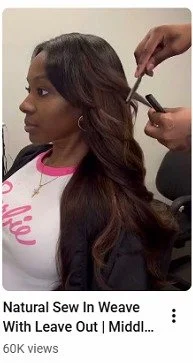
Want to see the finished look in action? I also have a quick YouTube Short showing a natural middle-part sew-in with leave-out.
Final Thought
A beautiful middle-part sew-in isn't about leaving out as much natural hair as possible.
It's about creating the right foundation, choosing the right extension texture, using enough leave-out to conceal the installation, and protecting that hair once you leave the salon.
When those pieces work together, the result shouldn't look like natural hair sitting on top of extensions.
It should simply look like your hair.
If you’re ready to stop guessing and start working with structure, education paired with the right service plan makes all the difference.
