K-Tip Extensions for Thin Hair: Are They a Good Choice?
If you have thin or fine hair, getting extensions can feel like a catch-22.
You want more fullness, but you don't want to put so much weight or tension on your natural hair that you create another problem.
That's why I’m particularly selective when recommending K-Tips for clients with thinner hair.
K-Tips can be a great option for some clients with fine or thin hair—but they need to be customized to the hair that's actually there.
Here's what you should know before deciding.
Why K-Tips Can Work for Thin Hair
K-Tips are individual extensions attached to small sections of your natural hair using keratin bonds.
Unlike a full weft, they can be placed individually.
That gives your stylist more control over:
Where fullness is added
How much extension hair is used
Bond size
Weight distribution
Areas that should be avoided
For the right client, this can create fullness without requiring a large amount of extension hair throughout the entire head.
Fine Hair and Thin Hair Aren't Exactly the Same
This distinction matters.
Fine hair describes the diameter of each individual strand.
Thin hair generally refers to having lower overall density.
You can have very fine strands but still have plenty of hair.
Or you can have thicker individual strands but lower density.
That's why simply saying, “My hair is thin” isn't enough to determine whether K-Tips are appropriate.
Your stylist needs to actually assess your hair.
1. Smaller Bonds Can Make a Big Difference
With thinner hair, bigger isn't better.
Using smaller, lighter K-Tip bonds can allow your stylist to create a more discreet installation while controlling how much weight individual sections of natural hair are supporting.
The bonds also need to remain hidden.
If your natural density is lower, standard-sized bonds may be too visible in certain areas.
This is where customization becomes important.
Your entire head doesn't necessarily need the same bond size.
2. More Extensions Don't Automatically Mean Better Results
If you have thin hair, the goal shouldn't necessarily be:
“How much hair can we add?”
A better question is:
“How much hair can your natural hair comfortably support?”
Those are very different approaches.
Trying to create extremely thick, waist-length hair on a naturally low-density foundation may require more weight than makes sense for that client.
Sometimes a smaller transformation looks better—and makes more sense for the natural hair.
Adding strategic fullness, improving the shape, or creating moderate length can still make a significant difference.
3. Placement Is Everything
There are areas where fine hair may not provide enough coverage to hide a K-Tip bond.
The hairline and sides can be especially delicate for some clients.
A good installation shouldn't simply fill every available space with extensions.
Your stylist should be thinking about:
Natural density
Coverage
Strength
Parting
How you wear your hair
Where additional weight makes sense
Sometimes the smartest placement decision is deciding not to put a K-Tip somewhere.
4. K-Tips Shouldn't Hurt
Extensions should not require you to accept ongoing pain as part of the process.
If your bonds feel excessively tight, heavy, or uncomfortable, contact your stylist.
With thinner hair especially, paying attention to tension matters.
Your installation should move naturally with your hair without making you feel like your scalp is constantly being pulled.
5. Your At-Home Routine Matters
A beautiful installation is only the beginning.
With K-Tips, you'll need to care for the attachment areas as your natural hair grows.
That includes:
Gentle, regular brushing
Keeping bonds separated
Thoroughly drying your roots
Avoiding heavy oils and conditioners directly on bonds
Protecting the hair while sleeping
Keeping direct hot-tool heat away from the keratin attachments
Thin hair doesn't need aggressive manipulation.
Your routine should be consistent but gentle.
When K-Tips May NOT Be the Right Choice
This is just as important as discussing the benefits.
K-Tips aren't automatically appropriate simply because someone wants more hair.
If your natural hair is extremely fragile, significantly damaged, actively breaking, or too sparse to comfortably conceal and support the bonds, another option—or postponing extensions altogether—may make more sense.
If you're experiencing unexplained or ongoing hair loss or scalp changes, that's also something to address appropriately rather than simply covering the issue with extensions.
The consultation should come before the installation.
What Should You Ask During Your Consultation?
If you have thin or fine hair, ask:
Is my current density suitable for K-Tips?
How much extension hair can my hair realistically support?
Will you customize the bond size?
Are there areas you plan to avoid?
What length and fullness would be realistic for me?
How should I maintain the bonds at home?
A good consultation isn't about convincing you to get K-Tips.
It's about determining whether K-Tips make sense for you.
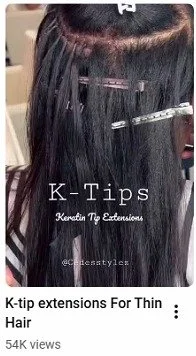
Watch K-Tips on Thin Hair
If you'd like to see how K-Tips can look on finer hair, I also have a quick YouTube Short showing the finished result.
Final Thought
So, are K-Tip extensions good for thin hair?
They can be—for the right client and with the right installation.
The goal isn't to take thin hair and attach as much extension hair as possible.
It's to work with the natural density you already have.
Smaller bonds, strategic placement, appropriate weight, realistic length, and proper maintenance can make all the difference.
Because with fine or thin hair, a successful extension transformation isn't necessarily about creating the most hair.
It's about creating the right amount of hair in the right places.
If you’re ready to stop guessing and start working with structure, education paired with the right service plan makes all the difference.
